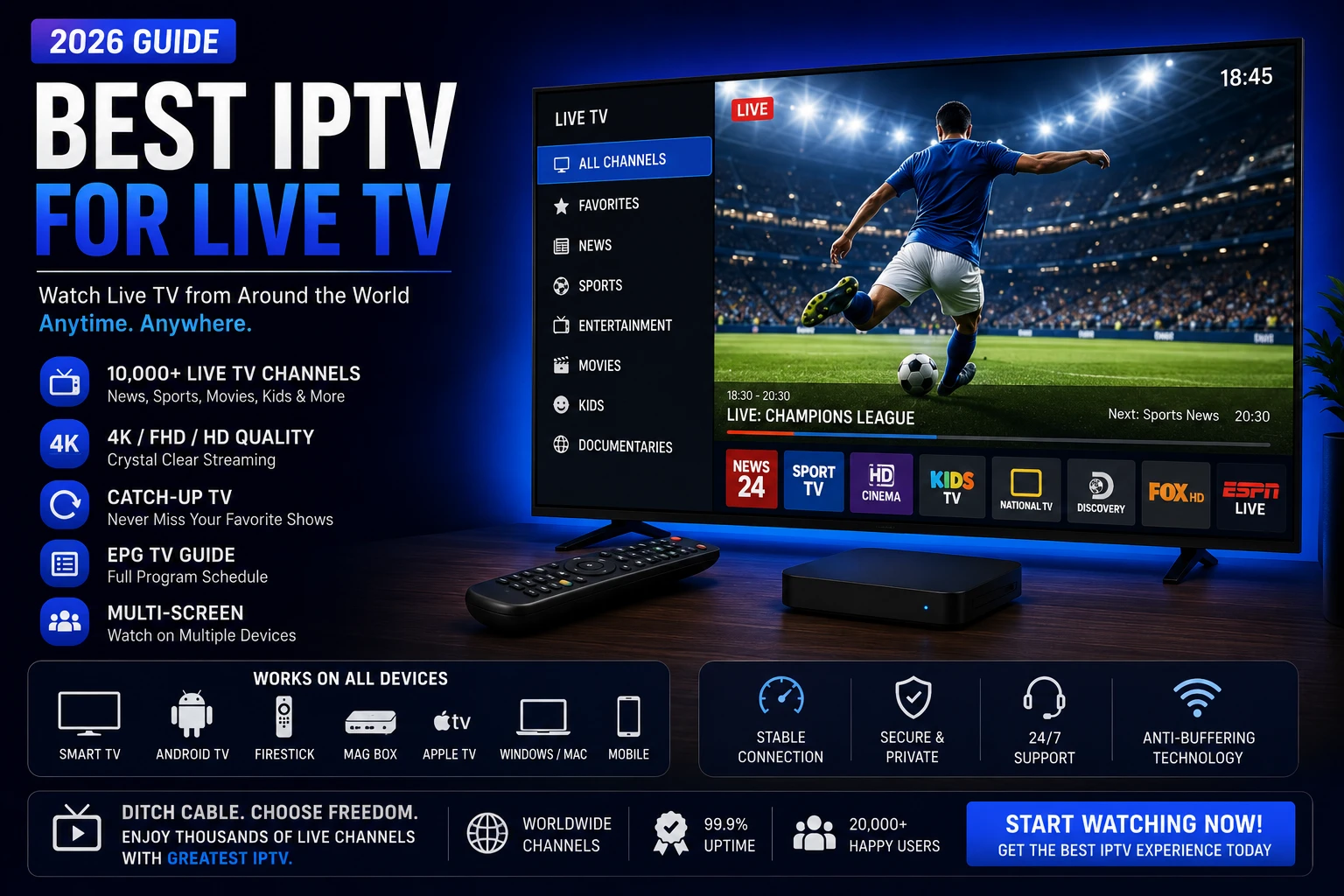
Quick Answer: What Is the Best IPTV for Live TV?
The best IPTV for live TV in 2026 is a setup that balances stable streams, accurate EPG, practical app navigation, and device compatibility. For most households, the strongest result comes from pairing a reliable subscription such as Greatest IPTV with a proven player app and a tuned home network. That combination reduces buffering, improves channel switching, and makes daily viewing much smoother.
When evaluating live TV IPTV options, prioritize consistent playback and organization over raw channel count. If guide data and app performance are weak, even large channel lists quickly become hard to use.
What Is Live TV IPTV?
Live TV IPTV means watching television channels in real time over internet protocol instead of traditional cable or satellite lines. The core experience is similar to classic TV, but delivery and management are software-driven through apps and network settings.
This model gives users more flexibility because channels can be viewed across multiple device types, with features like favorites, search, and EPG integrated into the interface.
Why People Switch from Cable TV to IPTV
The shift from cable to IPTV is usually practical, not trendy. Users move when they want better control, easier multi-device access, and modern app workflows.
- Flexibility: watch in living room, office, or mobile context.
- Modern interfaces: favorites, categories, and quick search.
- Content breadth: live channels from multiple regions.
- Usability: easier account and device management.
For users comparing entertainment-first and sports-first profiles, the dedicated guides for Best IPTV for Movies and Best IPTV for Sports help refine setup choices.
Live TV Channels Across Countries and Categories
A quality live-TV setup is not only about having channels. It is about being able to find, preview, and trust them quickly. Effective live-channel organization should include:
- News: local and international updates with stable uptime.
- Sports: live fixtures and event channels with accurate scheduling.
- Entertainment: movies, series channels, and general programming.
- Kids: dedicated family-safe category navigation.
- Documentaries: clear grouping for educational and factual content.
International coverage matters because viewers often need channels from multiple countries in one interface. EPG and category tagging are critical for making those large lists usable.
4K and Full HD live channels
Live 4K streams can look excellent on modern TVs, but they require stable throughput and capable devices. If your connection is inconsistent, stable Full HD is usually the better viewing choice. For technical context on high-resolution video, see Wikipedia’s summary of 4K resolution.
Catch-up TV and EPG value
Catch-up TV helps when you miss live windows, while EPG (TV guide) is essential for timing and navigation. If guide data is inaccurate, users lose confidence quickly. For EPG-specific fixes, use this IPTV EPG Not Working guide.
Best IPTV Apps for Smart TVs: Detailed Comparison
The app layer strongly affects live channel reliability and usability. The following comparison is based on real-world behavior for channel-heavy setups.
| App | Advantages | Disadvantages | Supported Devices | Ease of Use | Streaming Quality | Best Use Cases |
|---|---|---|---|---|---|---|
| IPTV Smarters Pro | Familiar UI, good for mixed household profiles, broad format support | Can slow down on underpowered devices if not maintained | Smart TV, Android TV, Firestick, mobile, desktop | Easy | Good to very good | Families needing straightforward daily live TV access |
| TiviMate | Excellent live-TV interface, strong EPG controls, multi-screen strengths | More advanced settings than beginners may need | Android TV, Firestick, NVIDIA Shield | Moderate | Very good | Users focused on premium live-channel navigation |
| SmartOne IPTV | Simple TV-oriented experience and clear onboarding | Less advanced deep-control features | Samsung, LG, Android TV | Easy | Good | Users wanting low-friction Smart TV setup |
| Smart IPTV | Long-running app with straightforward upload flow | Older UX compared with modern alternatives | Samsung, LG, selected Smart TVs | Moderate | Good | Users comfortable with classic TV app workflows |
| IBO Player | Fast onboarding, clean interface | Feature depth varies by platform and version | Samsung, LG, Android TV | Easy | Good | Households prioritizing ease and speed |
| XCIPTV | Flexible controls, strong Xtream handling, modern layout | Needs careful setup for best long-term stability | Android TV, Firestick, Google TV, mobile | Moderate | Very good | Users balancing control and usability |
For app-specific setup workflows, review IPTV Smarters Pro Setup, TiviMate Setup Guide, and XCIPTV Player Setup. These apps perform best when paired with a stable line and consistent network setup.
Comparison Table: IPTV vs Cable vs Satellite
| Criteria | IPTV | Cable TV | Satellite TV |
|---|---|---|---|
| Delivery method | Internet protocol streaming | Coaxial cable infrastructure | Dish and satellite signal |
| Device flexibility | High (TV, boxes, mobile, desktop) | Moderate (depends on provider hardware) | Moderate (mainly TV-centric) |
| Interface modernity | High with app-based controls | Varies by operator equipment | Often more limited customization |
| International channel access | Often broad | Usually package-dependent | Region and package dependent |
| Catch-up and app features | Strong in modern setups | Depends on operator features | Provider-dependent and sometimes limited |
| Installation overhead | Low to moderate | Moderate with provider scheduling | Higher due to dish setup |
Smart TV and Multi-Device Compatibility
The best live channels IPTV setup is one that works where you actually watch. Build around your primary device, then extend to secondary screens.
- Smart TV: easy living-room experience with direct app access.
- Android TV: robust ecosystem and better control options.
- Firestick: strong balance of affordability and app support.
- Apple TV: smooth hardware pipeline with compatible apps.
- MAG Box: still useful in stable TV-centric environments.
- Windows and Mac: practical for desk viewing and backup access.
If live playback fails intermittently, review this IPTV Playlist Not Loading guide and this IPTV Buffering Guide to isolate app and network root causes.
Internet Speed Recommendations for Live TV
| Usage Scenario | Recommended Stable Speed | Preferred Connection | Notes |
|---|---|---|---|
| Single Full HD channel | 15-20 Mbps | 5 GHz Wi-Fi or Ethernet | Good baseline for standard live viewing |
| Single 4K channel | 35+ Mbps | Ethernet preferred | Recommended for higher bitrate consistency |
| Two simultaneous streams | 50+ Mbps | Ethernet + quality router | Useful for family parallel viewing |
| High-load household | 100+ Mbps | Ethernet + QoS | Helps avoid peak-hour instability |
IPTV Security and Privacy Tips
Security is often ignored until something breaks. A safer live TV setup protects both account integrity and device health.
- Use strong unique passwords for IPTV account credentials.
- Avoid untrusted app sources and random APK websites.
- Keep apps and device firmware updated regularly.
- Secure your router with current encryption and admin password.
- Use trusted DNS configurations and monitor unusual behavior.
For official platform-level references, consult Android Developers TV docs, Google TV Help, Amazon Fire TV, and Apple Support.
Warning
Do not share account details across untrusted devices. Account leakage and insecure app installs are common causes of long-term stability and privacy problems.
Live TV Quality Audit: How to Evaluate Your Setup Like a Pro
Most users evaluate live TV performance emotionally, usually after one bad evening. A better method is to run a simple quality audit and score your setup objectively. This helps separate random one-off incidents from persistent technical weaknesses.
| Audit Area | Healthy Result | Risk Indicator | Practical Fix |
|---|---|---|---|
| Channel switching speed | Switches in a few seconds consistently | Long loading delays during peak hours | Optimize device performance and reduce background traffic |
| EPG accuracy | Current and upcoming programs match real schedule | Wrong titles, missing rows, time offsets | Refresh playlist/EPG and verify timezone settings |
| Prime-time stream stability | No repeated buffering over 30 minutes | Frequent pauses during popular events | Use Ethernet and apply structured buffering diagnostics |
| Category usability | News, sports, kids, docs easy to locate | Crowded menus and hard-to-find channels | Reorganize favorites and reduce noisy groups |
| Cross-device consistency | Works similarly across TV and backup devices | Only one device behaves correctly | Re-check app compatibility and account profile setup |
Channel workflow playbook for families
Live TV becomes much easier when each household member can quickly reach their preferred sections. Use a practical channel workflow instead of relying on one giant unfiltered list:
- Create favorites by intent: morning news, evening sports, kids-safe channels, weekend documentaries.
- Use EPG previews before switching: this cuts random channel hopping and reduces stream load spikes.
- Set one backup app profile: useful during major live events when primary app responsiveness drops.
- Schedule short maintenance windows: clear cache and refresh guide once every few days, not every hour.
International channel strategy without clutter
Users often want channels from multiple countries, but large multi-region lists can become overwhelming. The cleanest approach is to keep your daily regions in favorites and archive less-used regions into secondary groups. This preserves discovery while maintaining fast navigation.
When done right, international live TV feels curated instead of chaotic. This is one of the main quality differences between a basic setup and a production-ready home configuration.
What to check before high-demand events
- Open EPG and verify event timing in your local timezone.
- Run a five-minute channel stability test on the same device you will use.
- Pause heavy cloud backups and large downloads at home.
- Confirm your backup app or fallback channel path is available.
- Avoid last-minute setting changes once playback is stable.
This pre-event discipline takes under ten minutes and prevents most avoidable live-viewing failures.
Step-by-Step Live TV IPTV Setup Workflow
Step 1: Choose your primary viewing screen
Optimize for your main TV first. This ensures your best experience happens where you spend the most viewing time.
Step 2: Install one reliable app and configure properly
Start with one player, configure EPG and categories, and verify channel switching behavior before adding alternatives.
Step 3: Validate EPG and catch-up behavior
Check whether guide timing and replay windows match your region and routine. Correct this now to avoid daily frustration.
Step 4: Tune network performance for peak hours
Use Ethernet when possible, reduce background traffic, and test during your real peak usage window.
Step 5: Keep support path ready
If issues appear, use Contact with exact details. For plan decisions and activation, use Pricing and proceed via Checkout.
Voice Search and Related Queries
Common voice and search intents this page is optimized for include:
- What is the best IPTV for live TV in 2026?
- How can I watch live TV online without cable?
- Which IPTV app is best for Smart TV live channels?
- How much internet speed do I need for 4K live TV?
- How do I fix live IPTV buffering and guide issues?
Related searches users typically compare
Live TV users often compare adjacent topics before subscribing. Covering these topics in one workflow improves decision quality and reduces setup mistakes:
- best live tv streaming service for Smart TV
- watch live tv online with catch-up
- best app for live channels iptv on Firestick
- how to configure EPG for live tv iptv
- iptv vs cable cost and flexibility
Addressing these related intents early helps users build a stable setup faster and strengthens long-term satisfaction with daily live viewing.
Frequently Asked Questions
It is real-time TV streaming delivered over internet protocol through compatible apps and devices.
They want more flexibility, app-based control, and easier multi-device access.
Yes, when both network conditions and device capability are sufficient for stable high-bitrate playback.
Many setups do, and category organization helps keep these large channel lists usable.
Very important. Accurate EPG improves channel discovery and helps users avoid missing programs.
Catch-up lets you watch selected programs after broadcast windows, which helps with schedule conflicts.
IPTV Smarters Pro and SmartOne IPTV are often easier first choices for many users.
Yes, with compatible apps and properly configured account details.
Prioritize Ethernet, reduce network congestion, and keep app/device software current.
Focus on reliability, app compatibility, EPG quality, and support responsiveness before long-term use.
Final Recommendation
The best live TV IPTV setup is the one you can trust every day: fast channel switching, stable playback, organized categories, and accurate guide data. If you want a practical long-term solution, combine a reliable subscription with the right app and a tuned home network.
For many households, Greatest IPTV is a strong live-TV option when paired with proven players like IPTV Smarters Pro, TiviMate, SmartOne IPTV, Smart IPTV, IBO Player, or XCIPTV. The key is choosing the app that fits your device and usage style, then optimizing once and keeping it consistent.
Before committing long term, run a one-week trial workflow on your primary device at real viewing hours. Track channel-switch speed, EPG accuracy, and buffering rate during peak periods. This simple measurement habit prevents poor decisions and gives you confidence that your setup is production-ready for daily live viewing.
Ready to improve your live TV experience?
Choose a stable plan, configure the right app, and build a smoother daily channel workflow.