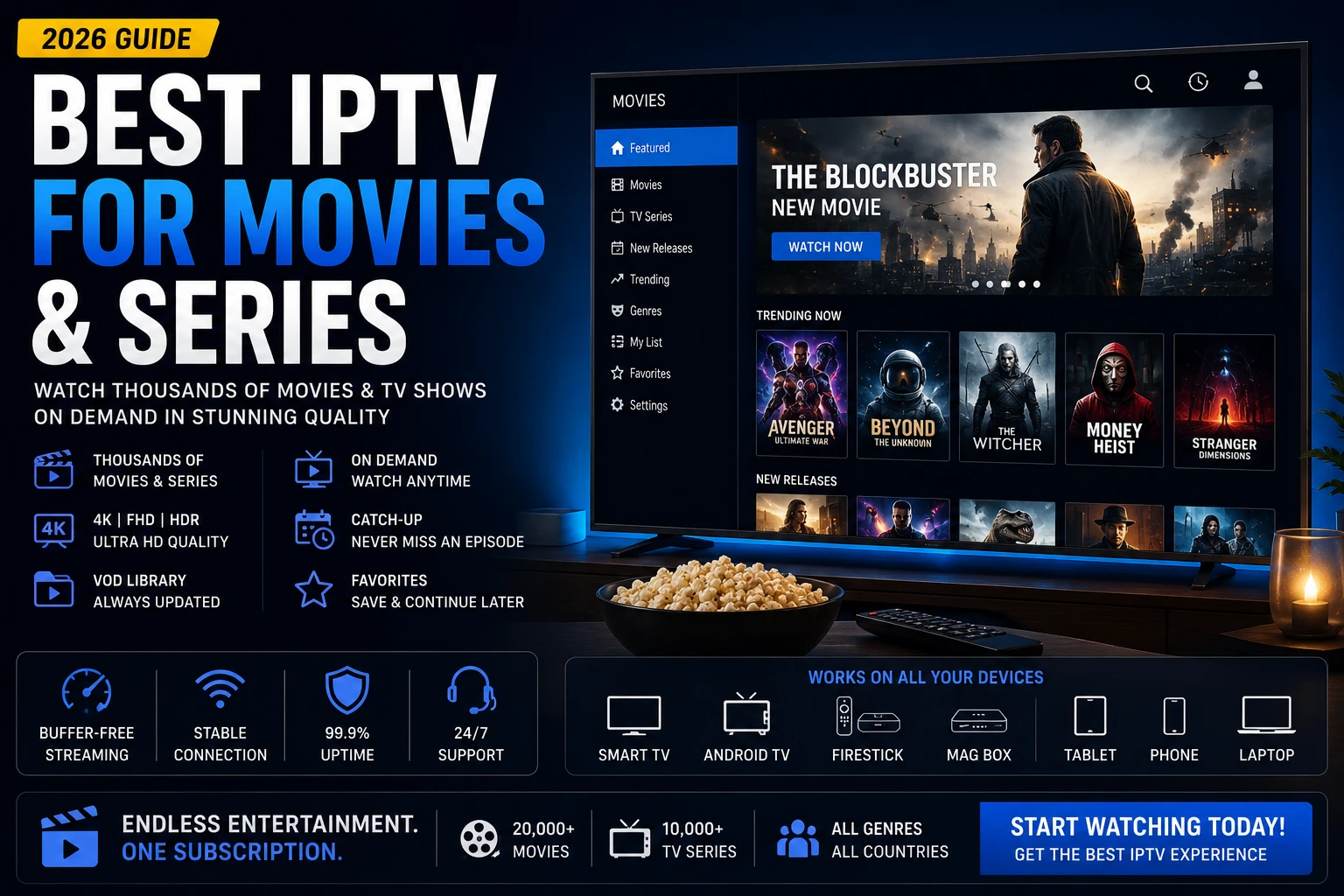
Quick Answer: What Is the Best IPTV for Movies and TV Series?
The best IPTV for movies and series in 2026 is a setup that combines stable VOD access, high playback quality, clean app navigation, and reliable multi-device support. If you want fewer interruptions and better content organization, pair a proven player app with a dependable subscription such as Greatest IPTV, then optimize your home network for sustained streaming.
Movie-focused users should prioritize VOD quality, search speed, favorites management, and device consistency over raw catalog size alone. In practice, this produces a better long-term experience than chasing unstable "feature-heavy" options.
Why IPTV Is Ideal for Movies and TV Series
Traditional viewing models still work, but they are often rigid for modern habits. IPTV is attractive for movie and series users because it supports on-demand consumption, multi-device continuity, and a more customizable watching workflow.
Key reasons users prefer IPTV for movies include:
- On-demand flexibility: start when you want, not when the channel schedule decides.
- Cross-device access: continue a movie from Smart TV to tablet or desktop.
- Category-driven discovery: faster browsing by genre, release year, or language.
- Search and favorites: save series and return instantly.
- Better household usability: each person can build their own watch path.
If your family also watches live events, pair this with the dedicated Best IPTV for Sports guide to build one consistent home setup.
4K, Full HD, and HDR Streaming Quality
High-quality video is one of the biggest reasons users search for the best iptv for movies. But quality is not only about the source file. It is a combination of source bitrate, app decoding behavior, device capability, and network stability.
What to expect from 4K movies IPTV
4K content can look excellent, especially on larger Smart TVs. For most users, the best experience comes from a stable stream at slightly lower peak bitrate rather than frequent quality drops. If you are deciding between unstable 4K and stable Full HD, choose stability first, then optimize upward.
For technical context on HDR behavior and visual range, Wikipedia offers a clear explanation of HDR video.
Practical quality checklist
- Use a device that can decode 4K/HDR reliably.
- Prefer Ethernet for your main TV when possible.
- Avoid heavy background bandwidth use during movie nights.
- Keep your player app updated for better codec support.
Video On Demand (VOD): Latest Movies, TV Shows, and Organization
A strong VOD system is not just a large library. It is a library you can actually navigate. Good VOD design includes consistent categories, accurate metadata, quick search, and favorites that sync logically across sessions.
What good VOD organization looks like
- Clear categories: action, drama, comedy, documentaries, kids, and regional sections.
- Latest titles surfaced clearly: new movies and recent episodes easy to spot.
- Reliable search: title lookup without long delays.
- Favorites/watchlist tools: save and resume faster.
- Series structure: seasons and episodes grouped correctly.
These details are what separate a useful daily streaming setup from a frustrating one. If your app becomes slow as the library grows, review the player comparisons below and consider adjusting your app choice.
Best IPTV Apps for Smart TVs: Detailed Comparison
Many users ask for one universal winner, but app performance varies by device and usage style. The table below compares practical behavior for movie and series streaming.
| App | Advantages | Disadvantages | Supported Devices | Ease of Use | Streaming Quality | Best Use Cases |
|---|---|---|---|---|---|---|
| IPTV Smarters Pro | Friendly interface, strong VOD layout, popular and familiar controls | Can require cache maintenance on older devices | Smart TV, Firestick, Android TV, mobile, desktop | Easy | Good to very good | Families wanting simple movie and series navigation |
| TiviMate | Excellent UI polish, strong control options, stable on capable hardware | Initial setup is more advanced | Android TV, Firestick, NVIDIA Shield | Moderate | Very good | Users who want premium control and refined playback behavior |
| SmartOne IPTV | Simple onboarding and TV-first design | Less advanced fine-tuning | Samsung, LG, Android TV | Easy | Good | Quick living-room setup with low learning curve |
| Smart IPTV | Established app, straightforward upload model | Older interface and fewer modern conveniences | Samsung, LG, selected Smart TVs | Moderate | Good | Users already comfortable with legacy TV workflows |
| IBO Player | Clean design and fast setup | Feature depth varies by platform | Samsung, LG, Android TV | Easy | Good | Users who want straightforward movie browsing on TV |
| XCIPTV | Flexible settings, modern interface, strong account handling | Needs proper configuration to perform at its best | Android TV, Firestick, Google TV, mobile | Moderate | Very good | Users balancing ease of use and customization |
| OTT Navigator | Power-user filtering and content controls | Steeper learning curve for casual users | Android TV, Firestick, NVIDIA Shield | Advanced | Very good | Advanced users with large mixed libraries |
For deeper app workflows, review Best IPTV Apps for Smart TV, TiviMate Setup Guide, XCIPTV Player Setup, and IPTV Smarters Pro Setup. These players are most effective when paired with a stable subscription path like Greatest IPTV.
Multi-Device Compatibility: Watch Anywhere
Strong movie and series IPTV setups should be consistent across your main screens. If playback is great on one device but unstable on another, the issue is often app-device fit rather than subscription quality alone.
- Smart TV: easiest all-in-one living-room option.
- Android TV: broad app ecosystem and flexible tuning.
- Firestick: popular and affordable with excellent app support.
- Apple TV: smooth device performance for supported player options.
- Windows and Mac: useful for desk viewing and continuation workflows.
When choosing your long-term setup, think about where you watch most often. The best experience is usually built around your primary evening screen and then extended to secondary devices.
Buffer-Free Streaming Tips for Movies and Series
Buffering ruins immersion faster than almost anything else. The good news is that most issues are fixable with a structured workflow:
- Use Ethernet for your main TV if available.
- Keep your app and device firmware updated.
- Clear cache when responsiveness drops.
- Avoid major downloads during high-bitrate playback.
- Test another player app to isolate app-specific bottlenecks.
If buffering persists, follow this complete IPTV Buffering Guide to diagnose network, app, and source layers in the right order.
Warning for heavy binge-watchers
Do not change ten settings at once. Adjust one variable, test for 5-10 minutes, and document result. Controlled troubleshooting is much faster than random tweaking.
Internet Speed Recommendations
| Viewing Scenario | Recommended Stable Speed | Preferred Connection | Practical Note |
|---|---|---|---|
| Single Full HD stream | 12-20 Mbps | 5 GHz Wi-Fi or Ethernet | Good baseline for standard movie nights |
| Single 4K stream | 30-35 Mbps | Ethernet preferred | Reduces bitrate swings on high-action scenes |
| Two simultaneous movie streams | 50+ Mbps | Ethernet with quality router | Better for families watching different titles |
| Multiple users + smart home load | 100+ Mbps | Ethernet + QoS routing | Prevents peaks from causing random playback drops |
Step-by-Step Setup Guide for Movie-First IPTV
Step 1: Pick your main viewing device
Start with your primary evening screen, not your phone. This keeps your optimization process focused on where quality matters most.
Step 2: Choose app by usability and VOD behavior
Install one player with clean VOD navigation and test search, categories, and favorites before adding extras. Too many apps at once can complicate troubleshooting.
Step 3: Organize watch categories and favorites early
Spend ten minutes building category and favorites structure. This makes daily browsing much faster and keeps family usage simple.
Step 4: Validate playback quality by title type
Test one recent movie, one older catalog title, and one multi-episode series. This quickly reveals whether decoding or metadata handling needs adjustment.
Step 5: Confirm support path
Keep your account details accessible. If issues appear, use Contact with exact error descriptions and your device/app versions. For plan comparisons and upgrades, check Pricing and complete through Checkout.
Voice Search and Related Searches
This guide aligns with real user query patterns and voice intent, including:
- What is the best IPTV for movies in 2026?
- How do I watch movies with IPTV on Smart TV?
- Which IPTV app is best for series binge watching?
- What speed is needed for 4K movies IPTV?
- How do I fix buffering when watching IPTV series?
These search patterns support broader discoverability while keeping the page useful and practical for human readers.
Content Quality Checklist: How to Judge a Movie IPTV Setup
Many users choose based on promises instead of observable quality signals. A better approach is to evaluate your setup with a repeatable checklist. This gives you objective results and helps you avoid wasting time on unstable configurations.
| Quality Area | What Good Looks Like | Warning Signs | Action |
|---|---|---|---|
| VOD structure | Consistent categories, accurate posters, clear episode grouping | Disorganized folders, duplicate titles, missing seasons | Switch app profile or rebuild category/favorites setup |
| Playback consistency | Stable 30+ minute viewing without random quality drops | Frequent buffering every few minutes | Run network check and follow the buffering workflow |
| Search performance | Results load quickly and match expected titles | Slow indexing or poor title matching | Clear cache and test alternate app parser behavior |
| Multi-device continuity | Same account works reliably on main devices | Works on one device but fails on another | Re-check app compatibility and account configuration |
Real-world viewing scenarios and fixes
Use these common scenarios as a practical decision framework:
- Scenario 1: Movie starts in 4K then drops to low quality. This is usually network or router congestion, not always provider instability. Prioritize Ethernet and reduce competing traffic.
- Scenario 2: Series catalog exists but episodes are hard to find. This is often an app UI/metadata issue. Try a player with better category and season structuring for VOD-heavy use.
- Scenario 3: Playback is fine on phone but unstable on Smart TV. Older TV hardware or Wi-Fi radios can be the bottleneck. External streaming devices frequently solve this.
- Scenario 4: Search takes too long on large catalogs. Keep favorites curated and avoid overloading a single profile with unused groups and stale entries.
Advanced optimization for movie nights
If you regularly host family movie nights or shared watch sessions, use a pre-session optimization flow:
- Restart the app once before peak usage windows to clear stale state.
- Confirm your selected title launches quickly in your preferred quality mode.
- Preload one backup title so category navigation delays do not interrupt viewing.
- Keep one secondary app configured in case the primary player slows down.
- Document which device-app pair performs best and use that as your default profile.
This process may sound simple, but it creates a measurable improvement in perceived quality. Users who treat IPTV like a repeatable system rather than a random app list usually report better long-term satisfaction.
Helpful Authority References
For official platform behavior and compatibility notes, these resources are useful: Android Developers TV documentation, Google TV Help, Amazon Fire TV, and Apple Support for Apple TV.
Frequently Asked Questions
The best choice balances VOD quality, app stability, and device compatibility rather than relying on catalog size alone.
Yes, when your provider and app setup support consistent VOD updates and organized metadata.
Yes, especially when episode grouping, favorites, and search tools are configured correctly.
A stable 30 to 35 Mbps per stream is a practical target, with more bandwidth for multi-device households.
IPTV Smarters Pro and SmartOne IPTV are often easiest for beginners thanks to straightforward navigation.
Yes. Many players and workflows support desktop viewing, making it easy to continue watching across devices.
Use Ethernet when possible, avoid heavy parallel network usage, and keep your app cache and updates in healthy condition.
Large libraries become difficult quickly without clear categories, search, and favorites, which directly affects daily usability.
If your TV hardware is older, external devices like Firestick or Android TV boxes often provide smoother long-term performance.
Prioritize playback consistency, VOD organization quality, app compatibility, and support responsiveness before long-term commitment.
Final Recommendation
If your goal is a premium movie and series experience, focus on consistency first: stable VOD access, clean app navigation, and reliable multi-device playback. The best IPTV for movies is not just a long list of titles. It is a system you can trust every evening without constant troubleshooting.
For many households, the most practical path is to combine a reliable subscription like Greatest IPTV with a player that matches your device and usage style. That combination gives you better quality, smoother organization, and less friction over time.
Ready to build your movie-first IPTV setup?
Compare plans, choose the right app, and configure your devices once for smoother movie and series nights.