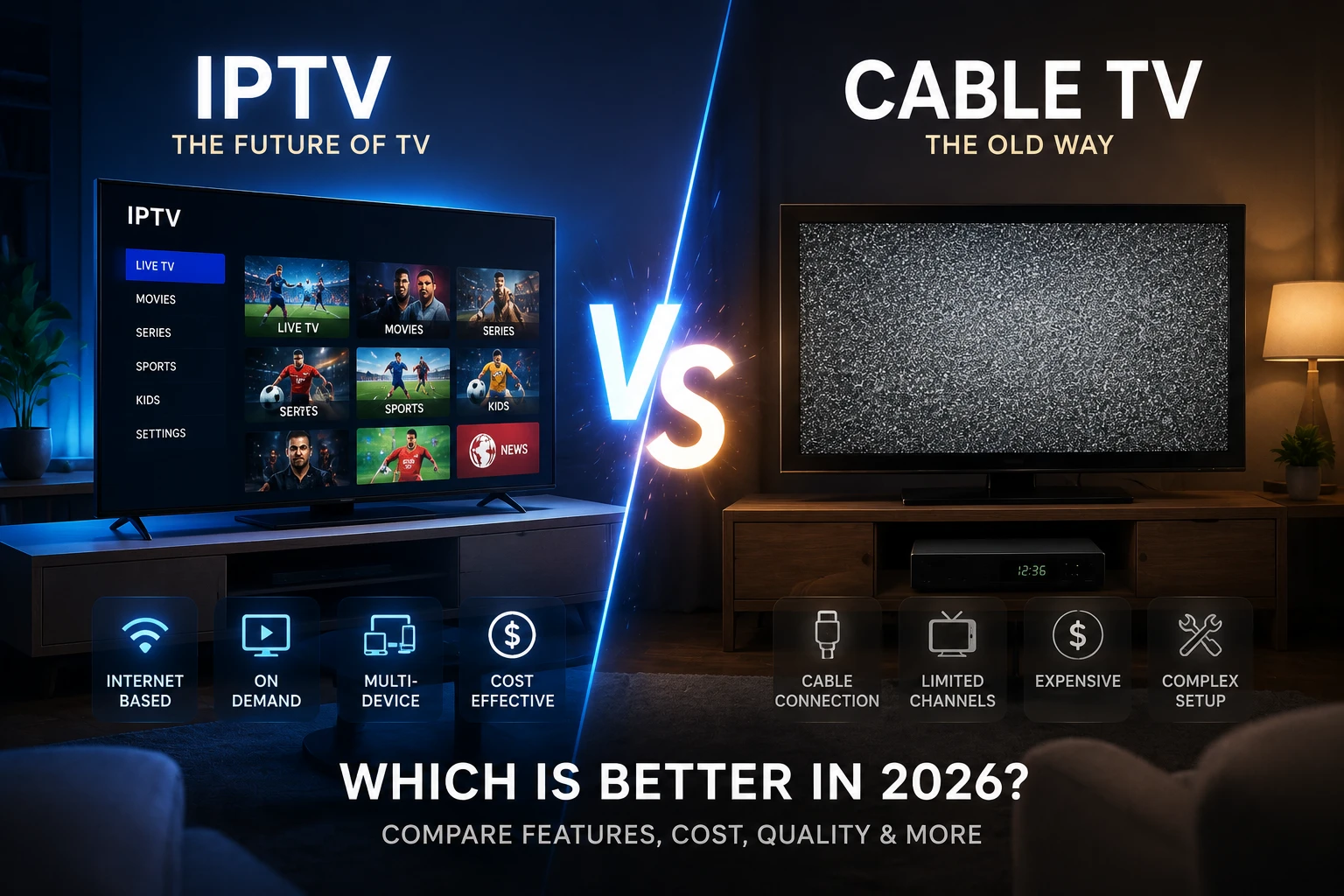
Quick Answer: Which Is Better in 2026?
IPTV is usually the better choice in 2026 if you want lower cost, more flexibility, modern device support, and the ability to watch on Smart TVs, Fire TV, Android TV, phones, tablets, and laptops. Cable TV can still be the better choice for households that value a familiar channel bundle, predictable service from one provider, and a setup that does not depend on learning a new app workflow.
The most practical answer is this: if your home already streams content comfortably and you want more control over what you pay for, IPTV usually wins. If your household wants one traditional bill, a local installer, and a conventional television experience, cable can still make sense. For many buyers, the best IPTV experience comes from pairing a dependable subscription with a reputable player and device setup, which is where a service such as Greatest IPTV USA fits naturally.
IPTV vs Cable TV: Side-by-Side Comparison
This table is the fastest way to compare the two options. The verdict column is not a marketing slogan. It reflects what most households feel once they actually live with each service for a few weeks.
| Factor | IPTV | Cable TV | Who usually wins |
|---|---|---|---|
| Monthly cost | Usually lower, especially when you only pay for the channels and features you actually use. | Usually higher once equipment fees, broadcast fees, and premium bundles are included. | IPTV |
| Setup | Often quick if you already have a Smart TV, streaming box, or app-supported device. | Usually requires provider installation or a cable box, but the process is familiar to many homes. | Depends |
| Device flexibility | Works on many devices, including Smart TVs, phones, tablets, laptops, and streaming boxes. | Mostly tied to the cable box and a limited set of provider apps or hardware. | IPTV |
| Channel bundle | More flexible, with some plans emphasizing live TV, sports, international content, or on-demand catalogs. | Usually easier to understand at a glance because the package structure is traditional and fixed. | Depends |
| Picture quality | Can be excellent when the internet connection and provider are strong, including HD and 4K playback. | Often stable and consistent, especially in areas with strong cable infrastructure. | Depends |
| Portability | Easy to use while traveling or on multiple screens, if your provider allows it. | Usually locked to the home installation and provider equipment. | IPTV |
| Contract pressure | Often easier to start without long commitments, depending on the provider. | Can involve bundles, promotions, and longer commitment periods. | IPTV |
| Reliability | Excellent with a strong provider and stable internet, but vulnerable to weak networks or overloaded home Wi-Fi. | Usually steady because the service is delivered over a dedicated cable infrastructure. | Cable |
| Channel discovery | Best when the app has a clean guide, favorites, and search functions. | Still easy for households that prefer a channel-number-driven viewing habit. | Depends |
| Overall value | Usually stronger if you want more control and a better price-to-feature ratio. | Usually stronger only if your household values traditional support and one familiar TV bill. | IPTV |
Cost and Value: What You Actually Pay For
Price is one of the biggest reasons people move away from cable. Traditional cable bills often start with a headline price that looks manageable, then climb once hardware, taxes, regional fees, DVR add-ons, and premium packages are included. IPTV is not automatically cheap, but it is usually easier to control because the monthly price is more transparent and the service can be tailored to the features you care about.
What makes cable expensive
Cable providers usually bundle channel access, set-top hardware, installation support, and regional fees into a monthly bill that looks simple from far away but gets more expensive in practice. Households often pay for channels they never watch just to keep a package active. The more rooms you want to serve, the more equipment or fees can accumulate.
What makes IPTV attractive
IPTV tends to feel more modular. You can use the service on a Smart TV, Amazon Fire TV, Android TV, or mobile device, depending on the provider and app. That flexibility matters because you are not paying for a rigid household setup. You are paying for a stream that can follow the way you already watch media. If you want to compare subscription options in more detail, the pricing page and Best IPTV USA 2026 guide are the best places to start.
Simple cost rule
If your household only wants live TV and a few common channels, IPTV often offers better value. If your family heavily uses legacy cable bundles, multiple premium add-ons, or a cable-installed DVR workflow, the cost difference may shrink faster than you expect. Always compare the real monthly bill, not just the advertised price.
Reliability, Picture Quality, and Daily Use
Reliability is where the cable argument remains strongest. Cable infrastructure is familiar, consistent, and not affected by the same local Wi-Fi issues that can impact a streaming setup. That said, cable reliability can hide a lot of waste: a reliable service is not automatically the best service if you are paying for features you do not use.
When cable feels better
Cable usually feels better in households where users want the same input, the same channel list, and the same button pattern every day. It can also be reassuring for people who prefer a provider technician to handle the installation and basic troubleshooting. For some families, that simplicity matters more than the price difference.
When IPTV feels better
IPTV feels better when your household already uses streaming apps and wants a single clean interface. With the right player, channel guide, and internet connection, it can be just as sharp as cable and much easier to use across multiple devices. The experience improves further when you pair the service with the right device and app setup, such as the smart TV guidance in our IPTV for Smart TV USA article or the installation walkthrough in the Smart TV setup guide.
Internet speed matters for IPTV
One reason cable still wins some comparisons is that IPTV depends on a stable internet connection. If your home Wi-Fi is weak, your router is old, or your internet plan is too slow for several simultaneous streams, IPTV performance can suffer. In that situation, the problem is not the concept of IPTV. It is the home network. Improve the network and the experience often improves dramatically.
Authority references for setup and device support
If you are checking compatibility before you switch, use official support sources. For Smart TV platform guidance, see Android Developers TV docs, Google TV support, and Apple Support for Apple TV. For device-specific streaming help, review Amazon Fire TV support.
Which Is Better for Different Types of Households?
The best choice changes once you look at who is actually using the TV. A good recommendation for a sports-heavy household may be wrong for a family that mostly watches kids' programming and movies. The cleanest way to decide is to match the service type to the household profile.
Choose IPTV if you want...
- Lower monthly bills with fewer unnecessary add-ons.
- Support for Smart TVs, streaming boxes, phones, tablets, and laptops.
- A setup that can travel with you or move between rooms more easily.
- More control over apps, guides, and device choice.
- A modern streaming experience rather than a fixed cable box workflow.
Choose cable TV if you want...
- A traditional channel-number experience that feels familiar to every member of the household.
- A single provider handling installation, troubleshooting, and household hardware.
- Service that is less dependent on your Wi-Fi quality.
- A conventional TV setup for older users who do not want to manage apps.
- A package tied to bundled internet or phone services that you already trust.
Where Greatest IPTV fits naturally
If you are leaning toward IPTV, the next step is choosing a provider that actually works well in the real world. Greatest IPTV is a sensible option for readers who want an IPTV subscription built around practical device support, usable setup guidance, and a direct path from research to viewing. You can review the main service overview, compare the USA service page, or visit checkout once you are ready.
How to Switch From Cable TV to IPTV
Switching does not need to be complicated. The biggest mistakes happen when people skip the prep phase and assume every TV, router, and app will cooperate automatically. This short process will save you time.
- Check your household devices. Make a list of the TVs, streaming boxes, phones, and tablets you actually want to use.
- Confirm your internet quality. If your network struggles today, fix that before you switch services.
- Choose a reliable IPTV provider. Focus on support, compatibility, and the realism of the channel setup, not just the headline price.
- Install the right player. On Smart TVs, use a player that is native to your platform when possible.
- Test live channels, EPG, and on-demand playback. Do this before you cancel cable, not after.
- Keep one backup plan for the first week. That makes the transition easier if you need to adjust settings or devices.
If you need a more detailed setup walkthrough for living-room devices, the best IPTV apps for Smart TV guide and the Firestick IPTV guide are helpful companion articles because the device side of the decision matters as much as the service itself.
Warnings before you cancel cable
Do not cancel your cable service until your IPTV setup has been tested on the actual screens in your home. Also avoid unstable Wi-Fi, weak routers, or unsupported apps. Most IPTV complaints are really home-network complaints. Fix the network first and the service becomes much easier to judge fairly.
Expert Tips for Choosing the Right Option
- Compare the real bill, not the advertised headline: Cable often looks cheaper until equipment and fees appear.
- Match the service to the household, not the hobbyist: What works for one user may not work for a family room.
- Check device support before you switch: Smart TV compatibility can save or ruin the experience.
- Use Ethernet where possible: A wired connection often improves IPTV more than any app adjustment.
- Test on the largest screen first: What looks acceptable on a phone can feel different on a 65-inch TV.
- Keep the app simple: A clean player with strong support is usually better than a flashy app you do not understand.
LSI Keywords and Related Searches
LSI keywords: streaming TV vs cable, cable alternative, IPTV service for Smart TV, live TV streaming app, internet TV subscription, cable replacement, IPTV player, smart TV streaming setup.
Related searches: is IPTV cheaper than cable, best cable alternative in 2026, does IPTV work on Smart TV, IPTV vs satellite TV, best IPTV for Samsung TV, how to switch from cable to IPTV.
Frequently Asked Questions
Is IPTV cheaper than cable TV?
In most cases, yes. IPTV is often cheaper because it removes the need for expensive equipment bundles and long channel packages you may never use. The exact savings depend on the provider and the internet plan you already have.
Is cable TV more reliable than IPTV?
Usually yes, especially if your home internet is inconsistent. Cable is delivered over dedicated infrastructure and does not depend on Wi-Fi quality. IPTV can still be very stable, but only when the provider and home network are both strong.
Can IPTV work on a Smart TV without a box?
Yes, many Smart TVs can run IPTV directly through a compatible app. Samsung, LG, Android TV, and Google TV users often have the easiest path. If your TV has limited app support, an external streaming device can help.
Which is better for sports, IPTV or cable?
That depends on what you value more. Cable can be very dependable for live sports, but IPTV can offer a better overall value if you want flexibility and device access. The best choice is the one that gives you stable playback during the events you actually watch.
Do I need fast internet for IPTV?
Yes. IPTV depends on internet quality, especially if multiple people are streaming at the same time or if you want HD and 4K content. A stable router and a strong connection usually matter more than raw speed alone.
Is IPTV legal?
IPTV itself is a delivery method. The legal question depends on whether the provider has the rights to distribute the content. Always choose a legitimate, transparent provider and verify that the service is suitable for your region.
Voice search version
If you are asking aloud, the short answer is: IPTV is usually better than cable TV in 2026 for most households that want lower cost, more flexibility, and Smart TV support, while cable still makes sense for users who want a traditional channel bundle and maximum simplicity.
Final Verdict: IPTV vs Cable TV
For most households in 2026, IPTV is the better choice because it offers more flexibility, better device support, and a stronger value proposition. It fits the way people actually watch TV now: on Smart TVs, phones, tablets, streaming boxes, and laptops. Cable still has a place, especially for homes that value a traditional setup, bundled service, and a fully conventional channel experience.
If you want the simplest recommendation, here it is: choose cable if you want the least amount of change and the most familiar workflow. Choose IPTV if you want a more modern setup that gives you control over your viewing experience and usually lowers your monthly cost. For readers who decide IPTV is the better fit, Greatest IPTV is a practical place to start because it pairs naturally with the device and app combinations covered in this guide.
Ready to Compare IPTV on Your Own TV Setup?
Use the app, device, and network setup that fits your household, then choose a subscription that matches it. If you want a straightforward IPTV path with clear support and flexible options, Greatest IPTV is the natural place to begin.